It was a mixture of chance, poorly tuned radio and much need for belonging.
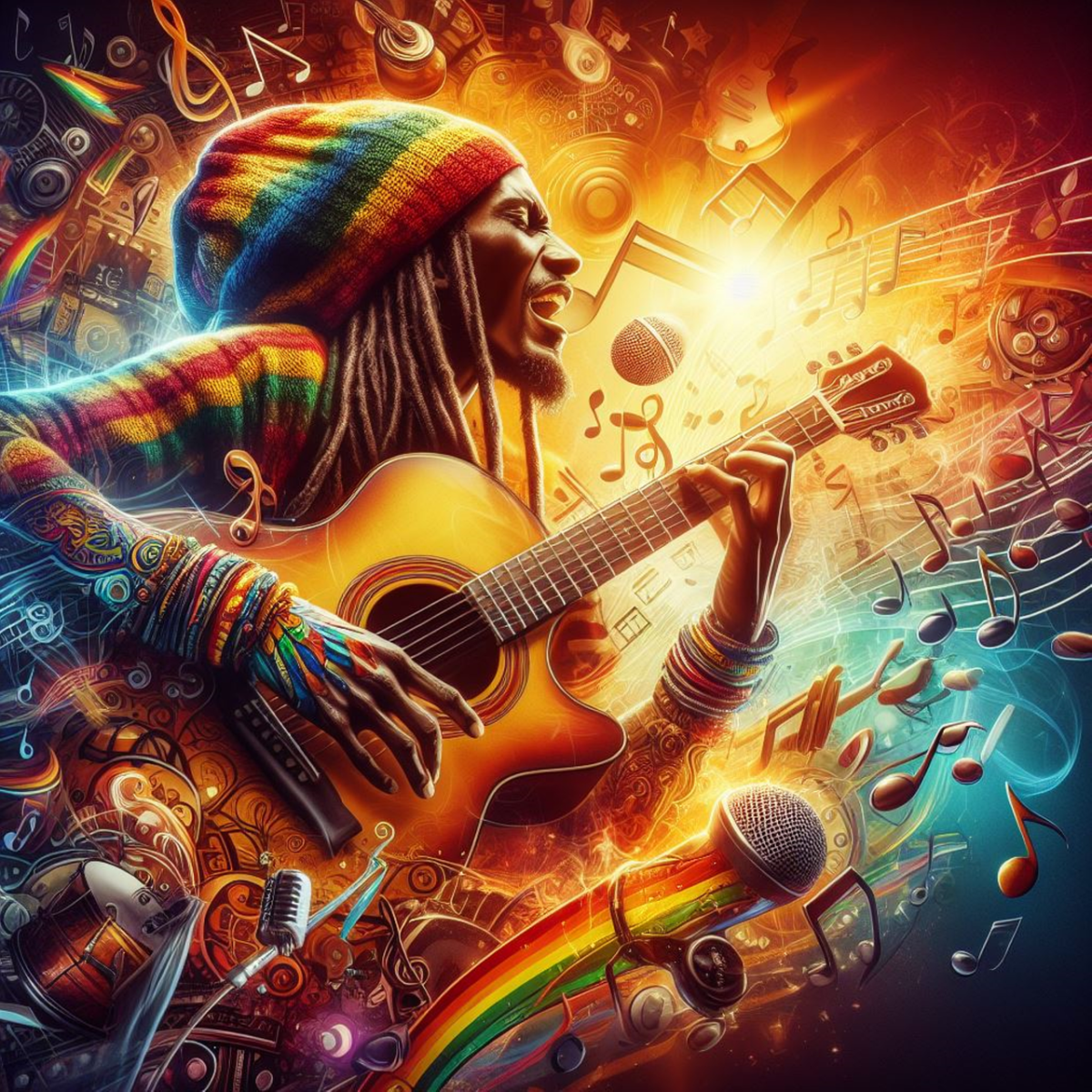
In the late 1960 ’ s and early 1970 ’ s, in São Luís, some people began to pick up in short waves Caribbean seasons. Another version of the story says it was sailors and dockers who brought Jamaican Vinis through the port. One way or another, the records have arrived.
The first one was DJ Riba Macedo in 1975. He began playing the parties on the outskirts and the rhythm instantly glued to the black youth of the city. It wasn't just the music. That's what the lyrics said about poverty, racism, resistance, black pride. It sounded like their story, except with another accent.
And then came what really changed everything: the radios.
Inspired by Jamaica's sound systems, they became giant walls of sound boxes with dozens of amplifiers, lights, and a DJ in charge. Names such as the Golden Voice Canarinho of DJ Locksmith, one of the pioneers, became legendary. They dominated the clubs and the street parties. The radio dispute took thousands of people. And every booming song turned into a "melo" or a "stone" – the crowd often didn't even understand English, but baptised the music for the chorus I heard.
The reggae from there also looked different. More romantic, slower, to dance with two, quite different from the original Jamaican swing. Mixed with Bumba My Boi, Creole Drum, capoeira. It became fashion, way to talk, to dress in the colors green, yellow and red, to cut the hair.
For a long time he was marginalized and even repressed by the police, but he became too big to ignore. Today São Luís has over 200 active radiolas, hundreds of bands like the Jah Tribe, radio shows, theme bars. In 2018 the city inaugurated the Reggae Museum of Maranhão, the first outside Jamaica and the second in the world, and officially won the Reggae National Capital title.
That's why the nickname got so strong. As the director of the Museum said, Ademar Danilo: the reggae is Jamaican, of course, but it is also Maranhense now. It didn't come as a foreign invader, it came as a brother who was born elsewhere.
Category: Music
-
Like Maranhão, Brazil became Brazilian Jamaica
-
Poetry: The Art That Gives Sense to Our World Pass.
Living is, first of all, an experience full of mysteries, contradictions and questions that rarely find definitive answers. In the midst of the daily rush, among worries, passing joys and pains that seem to have no name, we often feel that our thoughts are scattered, like leaves carried by the wind. It is in this scenario that poetry appears as one of humanity's deepest and most necessary creations: a delicate but firm bridge that connects us to ourselves and to the world that surrounds us.
The poetic creation functions as a special tool of mediation between the individual and the whole complexity of existence. By choosing each word carefully, by giving rhythm and form to what before was just a vague feeling or a whirlwind of confused ideas, the poet manages to do something extraordinary: he orders the chaos that exists within each of us. It gives visible form to what is abstract, voice to what was silent and felt to what seemed unexplained. This organization is not just an aesthetic exercise — It brings a deep, almost liberating relief. The small and great pains of everyday life cease to be isolated sufferings and gain the dimension of shared reflection, transforming personal experiences into something that belongs to everyone. Poetry thus becomes a mirror in which we recognize our own search, our fears and our deepest desires.
And its benefits go far beyond the simple pleasure of reading or hearing beautiful verses. As we approach lyrical art, we undergo transformations that touch the most intimate of our being. By putting us in the place of those who wrote, or by feeling what a verse awakens in us, we naturally develop a greater capacity to understand the pains, desires and motivations of others. — our empathy expands, and we realize that despite the differences, we share the same human essence. When we find in a poem words for what we feel but cannot say, our thoughts are organized, ideas are clarified and confusion gives room for a sense of peace and clarity. And, above all, poetry helps us build resilience: by seeing that feelings such as loss, longing or uncertainty have been lived and transformed into beauty by so many people before us, we gain strength to face the losses and challenges that are inevitable part of our journey.
The sensitivity that poetry awakens in us also brings a precious lesson: it shows us that the fullness of a life is not measured by how much we conquer or run, but by the intensity with which we live each present moment. In a world that always pushes us into the future, that makes us chase after what we do not yet have and forget what is before us, lyrical art teaches us to stop, observe and feel. When we opened up to her — especially for the richness of our brazilian literature, which portrays with such truth our way of being — we realize how poetry can capture, with a precision that reason sometimes does not reach, the essence of our brief, but precious, passage through the world. -
The Dictatorship of Algorithm: How Ready Playlists Mold Our Ears and Silence the Independents.
Imagine entering a coffee shop where the waiter, even before you open your mouth, already serves exactly your favorite coffee, at the perfect temperature. Comfortable, huh? Now imagine that this same waiter decides that from today, you only have the right to take infinite variations of that same grain, preventing you from knowing the taste of an exotic tea or a handmade blend from across the world. That's exactly what's happening to our relationship with music.
Today, the new generation no longer consumes albums; it consumes vibes. If you are sad, there is a soundtrack to cry in the room; if you are going to train, there is a rhythm millimetrically accelerated for your beats. At the heart of this invisible curatorship are the recommending algorithms of large streaming platforms. They decode our listening habits, map our seconds of attention, and subtly shape what we call "personal taste." The great irony of the era of musical abundance is that, with millions of songs just a click away, our auditory horizons seem to be narrowing into an ultra-personalized mesmice bubble.
This convenience has a high price, paid mainly by those at the bottom of the creative pyramid: independent artists. In the old days, the road to success passed through fanzines, community radios, basement shows and the classic mouth-to-mouth. There was a chaotic, unpredictable human factor in discovery. Today, for an independent artist to exist on the general public's radar, he must first decipher the enigma of the algorithm.
The challenge is Herculean. To be recommended, musicians are subtly pressured to conform to the rules of the digital game. This means creating songs with very short introductions to avoid skip in the first five seconds — a fatal metric that tells the system that the track "is not good" —, repetitive choruses that work well on dance videos and a production that fits perfectly into playlists of "background music". Art, before free to experience and miss, becomes cut not to disturb the ear of the middle listener. The sound of garage, experimentalism and artistic dissent struggle to breathe in an ecosystem that privileges homogeneity.
For the new talents who refuse to enter this assembly line, the feeling is to scream in the space vacuum. Without the initial push of editorial playlists or the favor of platform search engines, the work of months of composition runs the risk of accumulating only a few dozen reproductions. The algorithm creates a feedback cycle where what is already popular becomes even more giant, while the new and the different remain invisible.
However, not everything is dystopia. This algorithmic pressure has also caused a healthy resistance reaction. Attentive artists and listeners begin to rescue the value of human healing. The search for specialized newsletters, channels of content creators that prospect relics outside the commercial circuit and the return of physical media such as vinyl and cassette tape, which require active and ritualistic listening, is growing.
Music has always been a tool of human connection, rebellion and discovery. So that it doesn't just turn into a background noise designed to keep our brains anesthetized, we need to re-educate our curiosity. Drilling the algorithm bubble and actively seeking the unknown is not just supporting the artist independent of his city; it is an act of preserving our own sensitivity and cultural wealth that defines us. -

Música e Harmonia: Sintonizando a Mente na Frequência do Equilíbrio
A música é a linguagem universal que manifesta a Harmonia em nossas vidas. No BioBit.online, exploramos como as frequências sonoras e as composições autorais de reas63 funcionam como uma ponte para o equilíbrio entre a tecnologia e a emoção humana.
Sintonia e Equilíbrio
Viver em harmonia significa encontrar o compasso certo entre as demandas do mundo digital e a necessidade de quietude interior. A música nos ensina que o silêncio entre as notas é tão importante quanto o som, refletindo a atitude positiva de buscar o equilíbrio em tudo o que fazemos.
A Vibração da Atitude Positiva
Quando sintonizamos nossa mente na frequência da harmonia, nossas ações tornam-se mais fluidas e conscientes. A música não é apenas entretenimento; é uma ferramenta de alinhamento espiritual e mental.