
Ingredients
Mass (net 4 pizzas)
1000 g of wheat flour;
600 g cold water;
30 g of salt;
15 g of extra virgin olive oil;
5 g of dried biological yeast.
Coverage
fresh tomato sauce;
Fior di Latte cheese;
Basil leaves;
Garlic confit.
Method of preparation
Mass
Dissolve biological yeast in about 100 g of cold water.
In a large mass or bowl, put the wheat flour.
Add water gradually, mixing until all flour is incorporated.
Add the salt and keep mixing.
Add extra virgin olive oil and soak until you get a smooth, homogeneous and elastic mass.
Initial rest
Cover the dough with plastic film.
Let rest for 30 minutes at room temperature.
Division and billing
Divide the mass into four portions of approximately 400 g each.
Model balls very smooth and tensioned.
Place each in a lightly greased container with lid.
Fermentation
Take the pasta to the refrigerator for approximately 24 hours for slow fermentation.
Assembly
Remove the masses from the refrigerator between two and three hours before using them, keeping the containers capped at room temperature.
Sprinkle wheat flour or semolina on the counter.
Open the mass of the center to the edges, preserving the air bubbles formed during fermentation.
Spread the fresh tomato sauce.
Add the Fior di Latte cheese, basil leaves and garlic confit.
Bake in preheated oven at approximately 250 °C until the dough is golden and the cheese melted.
The long fermentation period is one of the great differentials of this recipe, providing a lighter, tasty and easily digestible mass. With simple ingredients and classic coverage, the pizza brings together traditional characteristics of Italian cuisine and can be reproduced at home for those seeking a more artisanal result.
Tag: Healthy habits
-

Italian Traditional Pizza
-
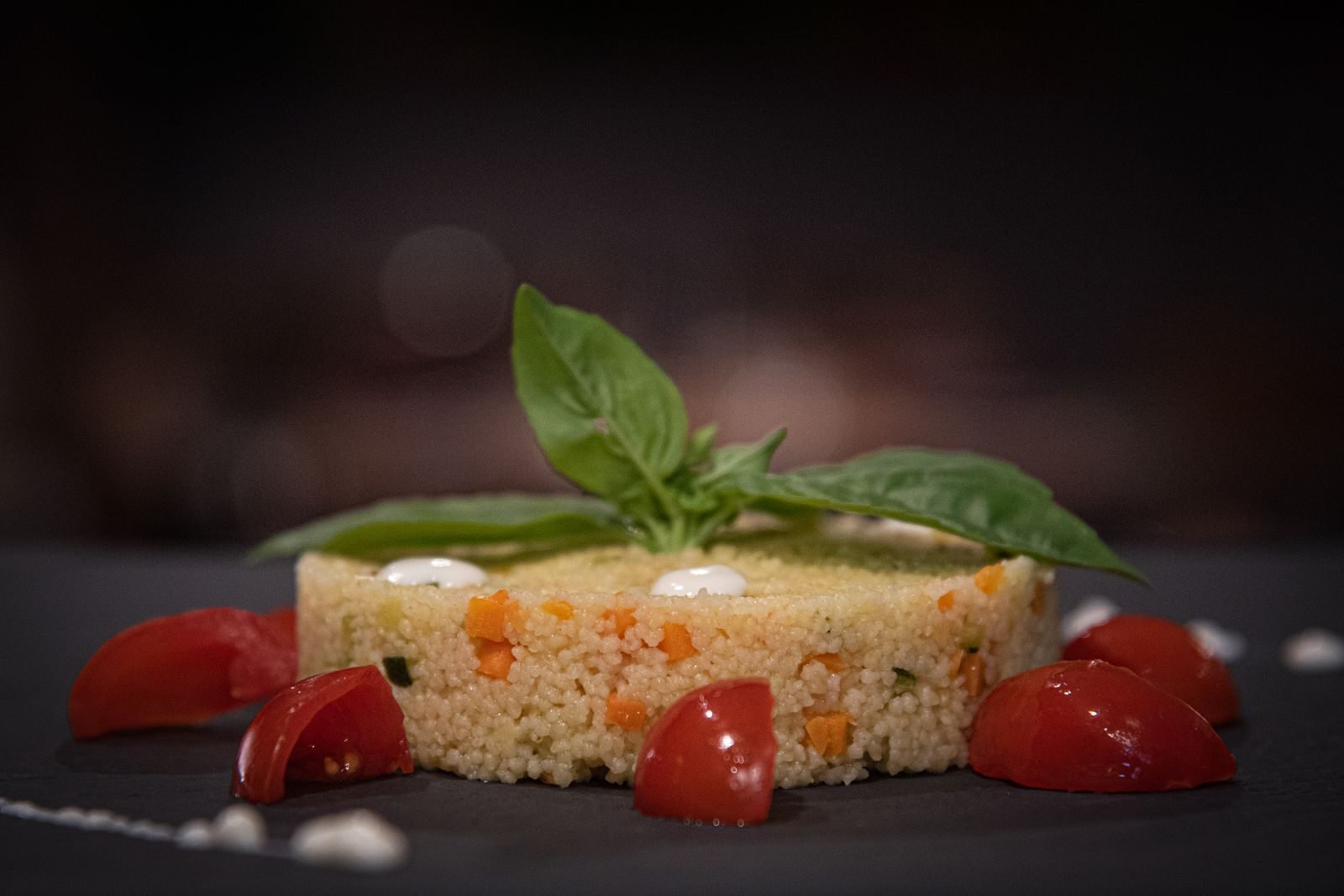
Revenue: Tomatoes in Brasa with Moroccan Cuscous, Buffalo Muzzarella and Parma Ham
Income: 1 portion | Preparation time: about 25 minutes
🛒 Ingredients
Tomatoes in Brasa
– 150 g cherry tomatoes
– 8 ml olive oil
– 2 g fresh thyme
– 2 g of salt
– 1 g minced pepper
– 3 ml reduced tucupi
Moroccan couscous
– 50 g Moroccan couscous
– 60 ml hot water (not boiling)
– 20 g carrot cut into brunoise
– 20 g of zucchini cut into brunoise
– 15 g of toasted cashew nuts
– 5 g of minced fresh parsley
– 3 g fresh mint mint mint mint mint
– 2 g of peppers cut into fine brunoise
– 8 ml olive oil
– 1 g of salt
– 1 g of lemon shavings (without white)
To finish
– 80 g fresh buffalo mozzarella
– 25 g of parma ham
– Cumari pepper sauce drops
👩🍳 Preparation Mode
Tomatoes in Brasa
4. Place the cherry tomatoes in a bowl, add the olive oil, thyme, salt and the pepper-of-the-kingdom, gently mixing to wrap them completely.
5. Bring it to the coal or oven at high temperature until it is lightly toasted and concentrated.
6. Still warm, finish watering with reduced tucupi and reserve.
Moroccan couscous
4. Place the couscous in a bowl, cover with hot water and let it moisturize for approximately 5 minutes. After that time, release the grains gently with a fork.
5. In a frying pan, quickly skip the carrot and zucchini in brunoise to keep the texture firm.
6. Add the vegetables to the already loose couscous, add the cashew nuts, parsley, mint, pepper, olive oil and lemon zest. Mix well and taste to adjust the salt if needed.
Crunchy Parma Ham
4. Lay out the ham slices over a baking machine lined with butter paper.
5. Bring it to the oven at 170 °C for about 8 minutes until it is golden and crispy.
6. Remove from the oven, let it cool completely and book.
Assembly
6. Place the couscous in the center of the plate forming the base.
7. Distribute the roasted tomatoes over the couscous.
8. Tear the buffalo mozzarella with your hands and spread over the ingredients.
9. Finish with crispy parma ham chips and discreet cumari sauce drops.
10. Serve immediately still warm. -

Poetry: The Art That Gives Sense to Our World Pass.
Living is, first of all, an experience full of mysteries, contradictions and questions that rarely find definitive answers. In the midst of the daily rush, among worries, passing joys and pains that seem to have no name, we often feel that our thoughts are scattered, like leaves carried by the wind. It is in this scenario that poetry appears as one of humanity's deepest and most necessary creations: a delicate but firm bridge that connects us to ourselves and to the world that surrounds us.
The poetic creation functions as a special tool of mediation between the individual and the whole complexity of existence. By choosing each word carefully, by giving rhythm and form to what before was just a vague feeling or a whirlwind of confused ideas, the poet manages to do something extraordinary: he orders the chaos that exists within each of us. It gives visible form to what is abstract, voice to what was silent and felt to what seemed unexplained. This organization is not just an aesthetic exercise — It brings a deep, almost liberating relief. The small and great pains of everyday life cease to be isolated sufferings and gain the dimension of shared reflection, transforming personal experiences into something that belongs to everyone. Poetry thus becomes a mirror in which we recognize our own search, our fears and our deepest desires.
And its benefits go far beyond the simple pleasure of reading or hearing beautiful verses. As we approach lyrical art, we undergo transformations that touch the most intimate of our being. By putting us in the place of those who wrote, or by feeling what a verse awakens in us, we naturally develop a greater capacity to understand the pains, desires and motivations of others. — our empathy expands, and we realize that despite the differences, we share the same human essence. When we find in a poem words for what we feel but cannot say, our thoughts are organized, ideas are clarified and confusion gives room for a sense of peace and clarity. And, above all, poetry helps us build resilience: by seeing that feelings such as loss, longing or uncertainty have been lived and transformed into beauty by so many people before us, we gain strength to face the losses and challenges that are inevitable part of our journey.
The sensitivity that poetry awakens in us also brings a precious lesson: it shows us that the fullness of a life is not measured by how much we conquer or run, but by the intensity with which we live each present moment. In a world that always pushes us into the future, that makes us chase after what we do not yet have and forget what is before us, lyrical art teaches us to stop, observe and feel. When we opened up to her — especially for the richness of our brazilian literature, which portrays with such truth our way of being — we realize how poetry can capture, with a precision that reason sometimes does not reach, the essence of our brief, but precious, passage through the world. -

Cathedrals of Light and Silicon: The Rise of Cyberspirituality in the Metaverse.
The silence preceding prayer has always had a physical texture. Historically, he leaned on the echo of the stone cathedrals, the aroma of incense burning slowly or the soft touch of beads between his fingers. Today, for a growing number of faithful, this same silence manifests itself in the slight buzz of a pair of virtual reality glasses and in the soft glow of an LCD screen that lights up before the eyes. The search for the sacred, far from being intimidated by the coldness of the programming codes, found in the metaverse a new and unexpected territory of expansion. It is the birth of cyberspirituality, a phenomenon that challenges our old boundaries between body, soul and pixel.
Entering a virtual temple is an experience that subverts the logic of traditional geometric space. A floating avatar can kneel before a three-dimensional digital altar, while the actual user is sitting in the armchair of his living room, thousands of miles away. Christian, Buddhist, Islamic and Neopagan communities have built true architectural masterpieces in digital space, where the laws of physics do not apply. In these places, gravity is optional, but communion is real. Virtual pastors preach to congregations of anthropomorphic avatars, while monks conduct collective meditations in digital Zen gardens that float over neon clouds. Faith, which always depended on symbols to become visible, found in the metaverse the definitive tool of visual representation.
This transition, however, does not occur without deep theological frictions. After all, how to adapt millennial rituals that intrinsically depend on the physical body? The consecrated host, the ablution with purifying water or the embrace of collective peace are tactile manifestations of belonging. In cyberspirituality, religions are forced to translate physical into symbolic in creative ways. The sharing of bread becomes an act of mutual intent; the imposition of hands becomes the alignment of two beams of digitized light. What at first may seem like an artificial simulation gains, for those who experience, a surprising emotional authenticity. For the human mind, the social presence and sensory immersion created by cutting-edge technology are capable of generating neurological responses of peace and reverence very similar to those of a brick temple.
Behind the dogmatic debates is a powerful humanitarian factor that drives this spiritual migration. For individuals suffering from social isolation, people with severely reduced mobility or those living under regimes where their beliefs are persecuted, the metaverse offers an unprecedented sanctuary of security and inclusion. Under the anonymity of an avatar, a young man can exploit his faith without fear of geographical or family judgment. Virtual space democratizes access to belonging, creating a global support network where physical distance ceases to be a barrier to mutual consolation.
It is evident that the metaverse will not replace the ancestral need for the encounter of flesh and bone, shared breathing, and the human warmth of a physical community. However, cyberspirituality reminds us that the sacred was never static. Just as the Gutenberg press transformed the reading of the scriptures and the radio brought the preaching into the homes in the last century, the immersive technologies are just the new language of a human search that never ceases. By building churches and temples of silicon, humanity proves, once again, that no matter how technological our reality is: we will always find a way to find room for mystery and transcendence. -

Small Changes, Great Results: The Power of Optimism in Wellness
The real personal transformation begins with the Optimism. When we decide to see the opportunities behind the challenges, small daily changes become fuel for extraordinary results in our health and mind.
The Power of the Positive Perspective
Cultivating optimism is not ignoring problems, but choosing to focus on the solution. At BioBit.online, we believe that this mental attitude changes our physiology, reducing stress and increasing clarity to make decisions that benefit our long-term well-being.
Inspiring Results
By integrating technology and a positive mentality, we can measure and celebrate every little progress. Optimism is the tool that keeps us on the path of constant evolution.

