There is a romanticized and almost heroic image that we cultivate on human discipline. We imagine the high-performance individual as someone with a locked jaw, veins protruding in the forehead and a superhuman ability to resist daily temptations. It is the myth of the warrior of willpower, the hero who wins daily battles against laziness, distractions and procrastination by the simple force of character.
However, the science of behavioral psychology brings a revealing and, in a way, humiliating finding to this narrative: the people who demonstratedly have the highest level of self-control are, in fact, the ones who least wage these heroic battles.
The answer to the consistency of these people is not in an unwavering ability to close their teeth, but in the fact that they have developed habits that make good behavior practically automatic. The secret that unites self-control to concrete results — as the quality of sleep, the consistency in studies and even the permanence in the university — It is not daily resistance, but habit.
The Architecture of Internal Silence
Literature reviews on the subject indicate that individuals with high self-control report less temptations in daily life. They are no better at resisting the song of the mermaid; they simply sail through waters where the mermaid does not sing. Instead of testing their own limits, these people shape the environment around them so that the tempting option is simply not before their eyes, allowing most of their day to pass through the autopilot.
This is where the routine reveals its true role, which goes far beyond the superficial clichés of productivity.
Psychologist Wendy Wood, reference in her studies on the subject, estimates that about 40% of all our daily behavior is governed by habits — automatic responses triggered by specific triggers such as a time, place or previous action —, and not by conscious and thoughtful decisions. A well-structured routine is nothing more than a chained sequence of these automatic patterns.
The real value of this automation lies not in the grandeur of the structure, but in the systematic elimination of the points of choice.
Every time a behavior requires a decision, you make room for an internal argument. — And every argument is an argument that you risk losing. When action becomes routine, debate ceases to exist. There is no deliberation, no weariness and no need to resist the alternative, because the alternative has not even been formulated by your mind.
An intelligent routine is, in essence, a way to spend energy of will only once: in the design phase of your day, and not in the daily execution of it.
The Design of the Environment and the Theater of Tiredness
The same logic applies to the physical and digital space surrounding us. Much of what appears to be an iron discipline is only the result of a well-designed environment — what researcher Angela Duckworth and her colleagues call situational strategies.
If the cell phone is on the table overnight, focusing on work will require an entire hour of continuous effort to ignore it. If the same phone is placed in another room, the effort drops to zero. The goal is always the same: to make the desired task the path of least resistance. It's infinitely easier to avoid temptation than to beat it over and over again.
Unfortunately, contemporary work culture and startup mythology interpret this concept almost in the opposite way. It sells the idea that the morning routine of 5 a.m. is the watershed between success and failure, ignoring genetic evidence that being a morning or night person is something deeply anchored in our biology.
The business ecosystem cultivates the cult of hard and visible work, where long hours at the table and apparent exhaustion function as a kind of performance. But this performance effort is just theater. Scientific research points in the opposite direction: what predicts real long-term achievement is the sober, repetitive and monotonous routine, which does not need audience or drama. Founders and professionals who last at the top are usually psychologically consistent, and the habit is precisely the engine that ensures this consistency without burning the start every morning.
A More Human Way to Live
However, the opposite extreme must be avoided. Installing a new routine is not a magical promise of absolute success. Several factors that determine one’s progress — as luck, financial resources, contact networks and health — are completely out of reach of an individual habit. Habit is a powerful lever, not the whole machine.
In addition, there is a risk of rigidity. A routine that eliminates unnecessary friction is a very useful tool; a routine defended with dogmatism becomes a prison. The same automatism that protects good behavior will protect a useless habit with the same fidelity if there is no discernment. The goal is not to stop thinking, but to stop deciding about things that should not require decision.
What this scientific perspective offers us, in the end, is a much more welcoming and realistic view of self-discipline. People who seem to have an inexhaustible willpower are not superhuman. They just organized their own lives to need it less and less.
This transition takes away from our shoulders the suffocating weight of trying to "make us stronger people" and transfers the task to something much more practical and attainable: the construction of a less stressful day.
Tag: #Article
-

The Myth of Will Force: Because the one with the most self-control is the one who needs it the least.
-
The Subtle Art of Drawing Own Existence: Like the Environment, the Past and Intuition Mold Who We Are.
There is an invisible architecture supporting each of our daily choices. We often believe that we are moved exclusively by the willpower, that our decisions come out of a vacuum of pure rationality and that the future is only a direct consequence of what we plan on paper. However, human life is a considerably denser tissue, woven by threads we often ignore: the spaces we inhabit, the meanings we attribute to our pains and the ability to listen to what pure logic usually discards.
Understanding this dynamic requires, first of all, looking carefully at the places and presences that surround us. There is a silent phenomenon called influence by resonance, a form of deep learning that does not depend on theoretical explanations or deliberate imitation. It is essentially simple permanence. You become, inevitably and gradually, the environments you frequent, the routines you repeat and the people you share your daily life with. Willpower is a finite resource; the environment, on the other hand, works without pause. If the structure around you plays against its essence, daily resistance becomes an exhaustive burden.
This same sensitivity needs to be directed inside, especially when we look at the path marks. For many thinkers throughout history, the past is inflexible in its facts, but absolutely plastic in its meanings. This is where one of the deepest tools of self-knowledge lies: the ability to reframe painful episodes without falling into the trap of denial. Resigning a wound does not mean pretending that the blow did not exist, nor to make it up with a naive and artificial optimism. It means facing the raw fact and at the same time deciding what effect it will have on your present. Scars cease to be monuments to suffering and become portals of maturity when we ask ourselves the fundamental question: what sense do I choose to extract from it today?
Living with consciousness is transforming apparent boundaries into thresholds, exchanging opaque walls for doors that open to the unknown.
Deepening this perception also requires expanding what we allow ourselves to notice. Daily life is sprinkled with synchronicities, intuitions that arrive ready without warning and dreams that insist on following the waking state. To ignore these signs by pure attachment to rational rigor is to smallen the experience itself. Paying attention to a coincidence that reorganizes paths or recording a recurring feeling is not abandoning reason, but recognizing that our mind captures patterns much faster than our language can translate. It is to resist the automatic impulse to discard the intangible and allow the limit of logic to become a threshold for new discoveries.
To navigate this ocean of perceptions without being lost, it is indispensable to build an internal compass, a true personal pantheon. We all carry references. — are historical figures, real mentors, literary characters or philosophical concepts. When we leave these diffuse references, they act in the shadow. However, by knowingly naming who we admire and mapping accurately what virtues these figures represent — be courage in the face of uncertainty, unnegotiable integrity or a serene way of being in the world —We turned passive inspiration into active guide. In times of crisis, this pantheon is evoked, offering clarity on which posture to adopt.
With a conscious environment, an integrated past, an awakening intuition and a well-defined pantheon, decision-making gains a completely new dimension. To decide wisely is not to act by impulse nor to be paralyzed by fear of the unknown, but to dwell in the field of possible futures before choosing one of them. It means testing the scenarios internally, anticipating the weight of repentance or the relief of coherence, and realizing which invisible forces are inflating our fears.
This posture does not eliminate the uncertainties inherent in life, but returns the role to the one who decides. Instead of just reacting to the circumstances as a drifting boat, you begin to navigate with an enlarged map, aware that each choice is ultimately the deliberate act of sculpting reality itself. -
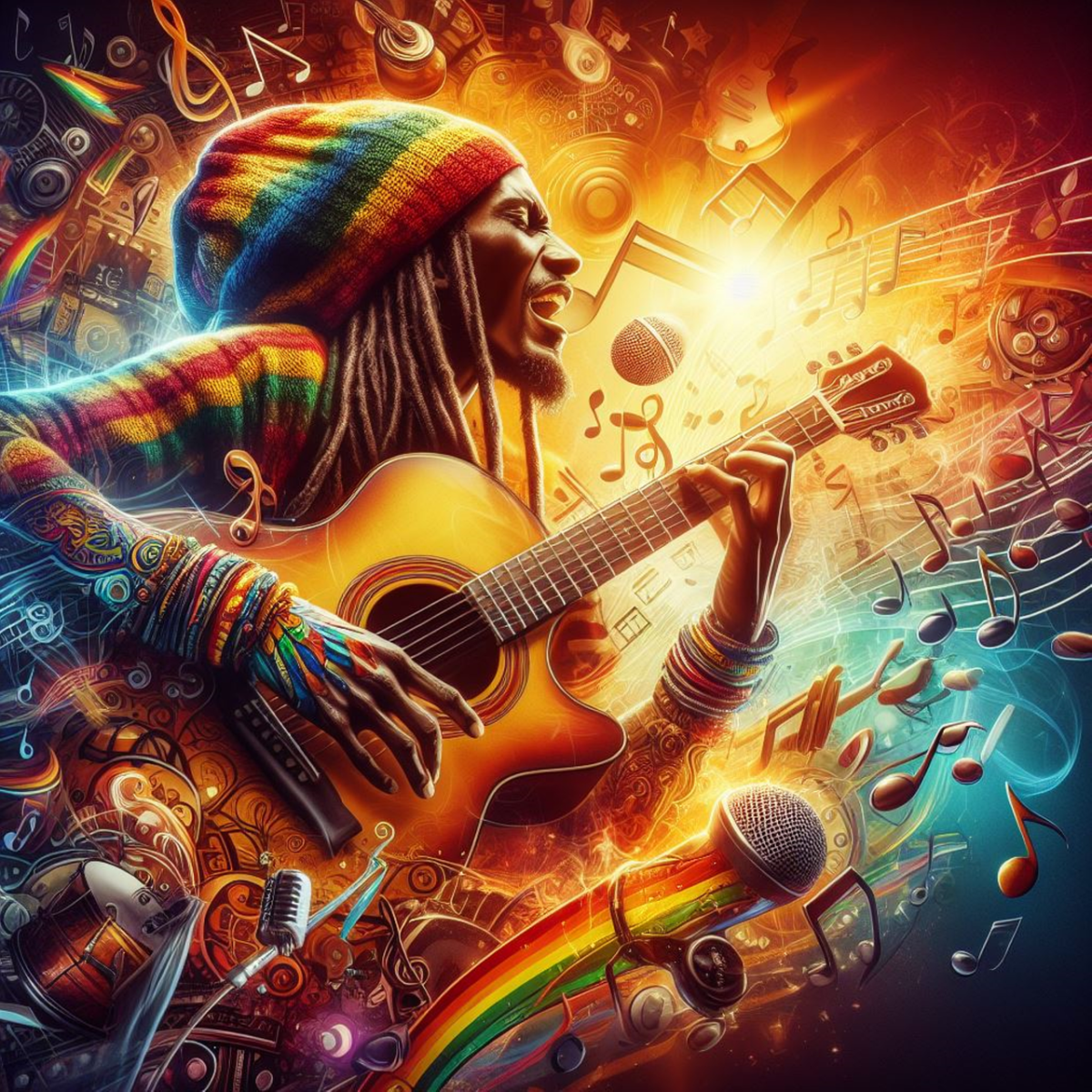
Like Maranhão, Brazil became Brazilian Jamaica
It was a mixture of chance, poorly tuned radio and much need for belonging.
In the late 1960 ’ s and early 1970 ’ s, in São Luís, some people began to pick up in short waves Caribbean seasons. Another version of the story says it was sailors and dockers who brought Jamaican Vinis through the port. One way or another, the records have arrived.
The first one was DJ Riba Macedo in 1975. He began playing the parties on the outskirts and the rhythm instantly glued to the black youth of the city. It wasn't just the music. That's what the lyrics said about poverty, racism, resistance, black pride. It sounded like their story, except with another accent.
And then came what really changed everything: the radios.
Inspired by Jamaica's sound systems, they became giant walls of sound boxes with dozens of amplifiers, lights, and a DJ in charge. Names such as the Golden Voice Canarinho of DJ Locksmith, one of the pioneers, became legendary. They dominated the clubs and the street parties. The radio dispute took thousands of people. And every booming song turned into a "melo" or a "stone" – the crowd often didn't even understand English, but baptised the music for the chorus I heard.
The reggae from there also looked different. More romantic, slower, to dance with two, quite different from the original Jamaican swing. Mixed with Bumba My Boi, Creole Drum, capoeira. It became fashion, way to talk, to dress in the colors green, yellow and red, to cut the hair.
For a long time he was marginalized and even repressed by the police, but he became too big to ignore. Today São Luís has over 200 active radiolas, hundreds of bands like the Jah Tribe, radio shows, theme bars. In 2018 the city inaugurated the Reggae Museum of Maranhão, the first outside Jamaica and the second in the world, and officially won the Reggae National Capital title.
That's why the nickname got so strong. As the director of the Museum said, Ademar Danilo: the reggae is Jamaican, of course, but it is also Maranhense now. It didn't come as a foreign invader, it came as a brother who was born elsewhere. -

The Eros Awakening: How to Return to Philosophy the Magic of Changing the World.
There was a time when philosophy was a matter of life and death. Socrates was not condemned to hemlock for publishing a high-impact article in an indexed journal; he was executed because his questions bothered power and transformed youth. Today, however, philosophy seems to have retreated to the comfortable silence of university offices. It degenerated into a hyper-specialized discipline, a glass game for beginners, more concerned with commenting on the past than deciphering the present. By moving away from the streets and the dynamic world, philosophy has lost its vital strength and, above all, its ability to produce a narrative of romance — that great history that incites the revolution, enchantment and social transformation. She's lost her power to change the world.
To reverse this scenario of intellectual sclerosis and rescue the lost magic of thought, we need to understand where philosophy went wrong. In trying to mimic the rigor of the exact and natural sciences to justify their institutional existence, philosophical thought sacrificed its mythical and affective dimension. Western philosophy has forgotten that the astonishment (thauma), the initial spark of every search for wisdom, is an aesthetic and existential experience, not a logical problem to be solved through insurmountable technical jargons. For philosophy to regain its real impact, it needs to be worldly, dangerous and passionate again. It must cease to be just an autopsy of dead ideas to become the diagnosis and creation of new realities.
It is precisely at this point of paralysis that art appears as a beacon of possibility. While philosophy was contained in the academy, art remained in a privileged position, capable of evoking the brightness of a new form of life. Art does not ask for permission from methodological rules to exist; it simply creates. It acts in the territory of affections, images and sensations — areas which pure reason often ignores, but which are the true engines of human action. It is very likely that art is, today, much closer to the essence of pure creation than traditional philosophy, for it not only describes the world, but subverts it and reinvents it before our eyes.
Therefore, the path to the resurrection of philosophy lies not in isolation, but in a radical alliance with artistic expression. Philosophy needs to re-approve of the poetic dimension. When conceptual thinking joins the creative and sensitive force of art, it ceases to be a mere bureaucratic exercise and becomes a transformative force. It is about turning concepts into flesh, and ideas into living images. Only when philosophers rediscover the audacity of artists — the right to err, shock, poetize and dream awake — is that philosophy will regain its charm and its power to shape the future. -
The Soul Filter: Why Undirected Intelligence Is It Just a More Sophisticated Mistake?
The true greatness of a mind is not measured by the power of its engine, but by the direction in which it chooses to walk. In a world that often confuses intellectual noise with wisdom, one must rescue an uncomfortable truth: intelligence alone is a neutral tool. Without an ethical and methodological orientation, it runs the risk of becoming just a terribly more efficient way of making mistakes. After all, the same brilliant mind capable of unraveling mysteries and finding innovative answers has the exact same ability to sophisticate excuses, manipulate facts in a subtle way, and consequently expand collective and individual damage.
We live in the advent of Artificial Intelligence, an extension of our own desire for infinite processing. However, the AI is the definitive mirror of this neutrality: it amplifies what we deposit in it. If the "prompt" of our soul is corrupted by the ego, the result will be a dystopia of purposeless efficiency. The digital future requires us to be more than mere users of algorithms; it requires us to be the architects of a new ethics that filters the coldness of data through the warmth of human consciousness.
Therefore, virtue is not born from the simple act of thinking, but from the exact moment when reason ceases to serve pride and comes to serve truth, responsibility and conscious choice. When the intellect is shielded by the ego, it becomes a fortress of illusions. For it to become an instrument of evolution, reason needs discipline. Thinking well does not mean hoarding a disordered volume of ideas or displaying erudition; it means ordering the path of research so as not to get lost in confusing impressions and passing impulses. It is the elementary difference between a mind that is a data deposit and a mind that is a beacon of clarity.
To guide the reason for this safe path, philosophy and method offer us four practical pillars of mental discipline that become even more urgent in the era of instant information:
- Avoid accepting something unclear: The first step of intellectual honesty is to refuse automatism, not taking as true what can still be legitimately questioned. In times of "fake news" and recommendation algorithms, healthy skepticism is an act of soul preservation.
- Split Difficult Problems: Given the complexity of the modern world, disciplined thinking operates as a surgeon, separating a complex issue into smaller and more understandable parts so that they can be digested without the anxiety of the whole.
- Moving from simple to complex: Solid knowledge builds its reasoning by gradual steps, without hasty leaps or conclusions drawn from nothing. It is the building of a solid foundation on which the future can rest safely.
- Review the whole way: Finally, the conscious thinker takes inventory of his own journey, thoroughly checking whether nothing important was left out or neglected by the way. It's the existential debug required for evolution.
By structuring the mind under these rules, the human being begins to understand its role in reality in a much more integrated way. In simple terms, thought belongs to the field of mind, a free, abstract territory focused on the search for meaning, while the body occupies space, moves and actively participates in the material world. It is through the action of the body that the choices of the mind come to life. When disciplined reason and the search for truth guide the soul, the division between what we think and what we do in the physical world ceases to be an abyss and becomes a bridge — where intelligence finally turns into practical wisdom.
The future ahead will not be defined by the speed of our processors, but by the depth of our filters. Let BioBit.online be the space where this filtering happens, where technology finds its ethical direction and where every bit of information is weighed in the balance of consciousness. The invitation remains: do not be just intelligent; be wise.

